Digital Intimacy: Now and into the Future
Jun
2
1:00 PM13:00

Digital Intimacy: Now and into the Future

  • 4TH SPACE, J.W. McConnell Building, Concordia University (map)
  • Google Calendar ICS

Hybrid event. To recieve the Zoom link, please register your attendance here.

Celebrating 5 years of the DIGS Lab

The Digital Intimacy, Gender and Sexuality (DIGS) Lab is celebrating its 5th anniversary with a launch for two fresh research outputs and an expert roundtable discussion. Join us to hear about a new tool – Safety Map – developed in collaboration with scholars across the CODER network to help people choose the safest dating app for them. Then we’ll showcase a new report about LGBTQ+ intergenerational dialogue on TikTok, looking at how the platform both helps and hinders queer people in connecting across generations.

Our roundtable panel will feature a range of experts in platform studies, digital methods, and digital sexuality studies to discuss our present moment and future directions for researching digital intimacy.

Program

1:00-1:10 Welcome and Introduction to the DIGS Lab

1:10-1:30 Launch: CODER Safety Map

1:30-1:45 Launch: Algorithms and “Elderqueers” Report

1:45-2:00 Audience Q&A / Short break

2:00-3:00 Roundtable – Our Digital Present and Future


Speakers (alphabetical order)

Alex Chartrand is a PhD Candidate in Communication Studies at Concordia University in Tiohtià:ke/Montreal and is a member of the Digital Intimacy, Gender & Sexuality Lab. His interests include online social movements, queer countercultures, platform governance, algorithmic studies and alternative use of technology. His work focuses on how LGBTQ+ users develop queer algorithmic imaginaries, i.e. vernacular and situated knowledge embedded in queer trajectories. In turn, he studies how these imaginaries inform resistance practices and culture online. 

Stefanie Duguay is the director of the DIGS Lab and has held a Concordia University Research Chair in Digital Intimacy, Gender and Sexuality. She is an Associate Professor in the Department of Communication Studies at Concordia University. Her research has involved studies of LGBTQ+ digital self-representation, dating apps, platform appropriation, social media governance, discourses of automation and algorithmic neutrality, and the role of social and mobile media in queer social landscapes. Her forthcoming book with Polity, Tinder: Digital Intimacy in the Dating App Era, will be available in November 2026.  

Hannah Jamet-Lange (she/they) is a researcher and course instructor at the Institut für Medienwissenschaft (Media Studies Institute) at Ruhr-University Bochum, Germany. She received her MA in Media Studies at Concordia University in Tiohtià:ke/Montreal, Canada, and is a former member of the Digital Intimacy, Gender and Sexuality (DIGS) Lab. Centred in affect and queer theory, their research interests revolve around social media, fandom studies, and queerness. Her current research examines queer youths’ music fandom practices on TikTok, particularly in relation to politicization of fandom, expressions of emotions, and queer identity conceptions. 

David Myles is an Assistant Professor at the Centre Urbanisation Culture Société, Institut national de la recherche scientifique (INRS) in Montréal. His research investigates the sociocultural and political implications of digital platforms, as well as the role of technologies in mediating popular and participatory cultures, with a specific interest in LGBTQ+ cultures. The development of critical methods to study digitally mediated phenomena is at the heart of his research interests, as well as the analysis of their ethical and epistemological implications.

Dunja Nešović is a PhD candidate in Communication Studies at Concordia University in Montréal/Tiohtià:ke and a lab coordinator/research assistant at the Digital Intimacy, Gender, and Sexuality (DIGS) Lab. In her doctoral research, she investigates the mediation of lesbian desire in the convergent digital media environment, with a focus on (reality) television and social media.

Skyler Wang is an Assistant Professor of Sociology at McGill University, a Research Scientist at Handshake AI, and the Director of the Social-Centered AI (SCAI) Lab. Using mixed-methods, experimental, and STS approaches, Skyler investigates the epistemic cultures of AI and human-machine interactions in a variety of contexts. His primary empirical focus is on how digital platforms—such as network hospitality, online dating, and AI companions—shape contemporary intimacy and relationships. Skyler’s work has been featured in journals such as NatureBig Data & SocietyInformation, Communication & Society, and Social Media + Society.

View Event →
[Symposium] JenniCam@30: Thirty years of live streaming cultures
Apr
14
10:15 AM10:15

[Symposium] JenniCam@30: Thirty years of live streaming cultures

  • Concordia University Downtown Campus (map)
  • Google Calendar ICS

April 14th, 2026, will mark 30 years since Jennifer Ringley, then a college student, mounted a digital camera on top of her computer in her dorm room and began streaming online. Ringley’s webcam, known as JenniCam, transmitted nearly uninterrupted for seven years, becoming the most enduring webcam performance of the early Internet. Despite not being recognized as a pioneer during her time, Jennifer Ringley made Internet history by pioneering live self-streaming.

We're meeting exactly thirty years later to celebrate JenniCam’s anniversary with a day-long event about and through live streaming practices.

Morning
10:15am-12pm – 4th Space, Concordia (LB-103)

JenniCam in Context: Keynote lecture by Susanna Paasonen (online), plus an in-situ conversation.

Afternoon
1:00pm-5pm –Speculative Life Cluster (EV-10.625), Milieux, Concordia

A pop-up live TV studio transmission hosted in collaboration with the Institute of Network Cultures.

Presentations and in-situ conversations include: Tommaso Campagna on live streaming as a form of publishing (TheVoid.TV); Geert Lovink on the lives of the online self (online); Seska Lee on camming and the construction of liveness; Lotte de Jong on webcam and art (online);  Uandha Fernandes Barbosa + Aalok Sud + Tara Halkiw presenting the live coding performance if (afk == false) stream(); Mark Sussman introducing pandemic object theatre, and Jas Nasty djing live (online).

Snacks and beverages will be provided at both locations.

Morning and afternoon (EST) events will be transmitted at Jennicam-at-30.com.

This event would not be possible without the generous and enthusiastic support of:

the Digital intimacy, Gender & Sexuality Lab (DIGS), Milieux Institute for Arts, Culture and Technology, Speculative Life-Machine Agencies, the Centre for Interdisciplinary Studies in Society and Culture (CISSC), COMS Concordia, Institute of Network Cultures, PLSM


For more information about the event, the JenniCam, and related web based art, visit Jennicam-at-30.com

View Event →
[Book Talk] Stephen Monteiro: How Tech Got Needy: Episodes in Device Intimacy
Mar
26
4:30 PM16:30

[Book Talk] Stephen Monteiro: How Tech Got Needy: Episodes in Device Intimacy

  • Milieux Resource Room (EV 11.705) (map)
  • Google Calendar ICS

On March 26, the DIGS Lab will host a book talk by Stephen Monteiro titled How Tech Got Needy: Episodes in Device Intimacy. This event is co-hosted by the Media History Research Centre, Milieux Institute, and the Department of Communication Studies (Concordia University).

No registration required. The event will be followed by a reception with light refreshments.

About the talk: Networked personal media devices construct an animated intimacy fostering user trust and emotional dependence. Viewing this development through an historical eye, this talk explores examples of object-oriented digital intimacy that emerged at the turn of the twenty-first century. Drawing from Needy Media (recently published by McGill-Queens University Press), it will consider how user-device closeness was baked into consumer electronics from 1995 to 2005 through a range of hardware and software cues. These elements collectively tapped psychological vulnerabilities toward affective impact, situating the device as a lively, but needy, presence in the life of users.

Speaker bio: Stephen Monteiro is a faculty member in Communication Studies at Concordia University. In addition to Needy Media, he is the author of The Fabric of Interface (The MIT Press) and Screen Presence (Edinburgh University Press), and the editor of The Screen Media Reader (Bloomsbury).

View Event →
[Workshop] Dr. Jennifer Pybus: Auditing Extractive Infrastructures of Datafication in Mobile Applications
Feb
25
2:30 PM14:30

[Workshop] Dr. Jennifer Pybus: Auditing Extractive Infrastructures of Datafication in Mobile Applications

In-person event.

Register for the workshop by sending an email to digslab@concordia.ca with your name, department, and level of study.

This workshop introduces an infrastructural mixed method for auditing how health apps embed third-party software development kits (SDKs) and access both personal and health-related data from mobile devices. The method includes (i) app selection based on relevant criteria, (ii) an assisted manifest data audit using a large language model (LLM), (iii) a qualitative examination of corresponding privacy policies and data safety agreements, and (iv) a walkthrough method, established by Light et al. (2018), to account for the different kinds of health and personal data that can be input in the apps’ interface. Rather than focusing primarily on user behaviour or consent, the method centres on qualitative analysis of Android manifest files, since any personal data an application seeks to access from a user’s device, or share with third parties, should be declared there. Participants will also be introduced to the role app events play in personal data tracking, and to how health-related data are structured in manifest files in ways that make them legible and reusable across a range of actors, including large platforms. By the end of the session, participants will have a clearer understanding of how to conduct a static audit of mobile tracking infrastructures and compare back-end findings with front-end privacy policies in order to better infer how personal and health data are extracted, shared, and monetised through third-party SDKs, and how these practices are, or are not, communicated to end users.

Important: Participants must pre-install software tools in advance of the workshop. Please register early to obtain the installation instructions and recommended pre-reading. Places are limited.

Jennifer Pybus is a globally recognized scholar whose interdisciplinary research intersects digital and algorithmic cultures and explores the capture and processing of personal data. Her work focuses on the political economy of social media platforms, display ad economies, and the rise of third parties embedded in the mobile ecosystem which are facilitating algorithmic profiling, monetisation, polarization and bias. Her research contributes to an emerging field, mapping out datafication, a process that is rendering our social, cultural and political lives into productive data for machine learning and algorithmic decision-making. Pybus has cultivated strong European links with public organizations and will use her chair to engage Canadians with innovative tools, resources and pedagogy for increasing critical data literacy and democratic debate about artificial intelligence.

This event is supported by the Canada Research Chair in Data, Democracy and AI, the Digital Intimacy, Gender and Sexuality Lab, Machine Agencies, and the Speculative Life cluster at Milieux.

Image credits: "iPhone 7 - Health App Opening Screen" by forthwithlife is licensed under CC BY 2.0.

View Event →
Pills, Clicks, and Bans: Auditing digital censorship of access to abortion and reproductive rights
Feb
6
10:00 AM10:00

Pills, Clicks, and Bans: Auditing digital censorship of access to abortion and reproductive rights

Event information is also available through 4th Space.

Abortion access and sexual and reproductive health rights (SRHR) currently face multiple barriers in online ecosystems. Women on Web, an abortion non-profit, is plagued with increasing digital suppression and censorship online. 

Concordia's Applied AI Institute and the Digital Intimacy, Gender, and Sexuality (DIGS) Lab have mapped how major information intermediaries — search engines, social media platforms and hosting services — restrict access to WoW’s website and services. 

We invite you to a first-hand look at the results, and what they indicate for Women on Web and online abortion access. We will be joined by members of the organization to help us unpack the findings, followed by a panel discussion of the implications they have about platform moderation and censorship of global reproductive health.

How can you participate? Join us in person or online by registering for the Zoom Meeting, or watch live on YouTube.

Have questions? Send them to info.4@concordia.ca

Schedule 

10:00am - 10:15am Welcoming and Networking

10:15am - 10:25am Women on Web (WoW) Introduction

10:25am - 10:50am Erin Hassard's Presentation

10:50am - 11:00amBreak

11:00am - 11:40am Roundtable Discussion

11:40am - 12:00pm Q&A

Speakers:

Stefanie Duguay

Fenwick Mckelvey

Erin Hassard

Venny Ala-Siurua

Jane Eklund

View Event →
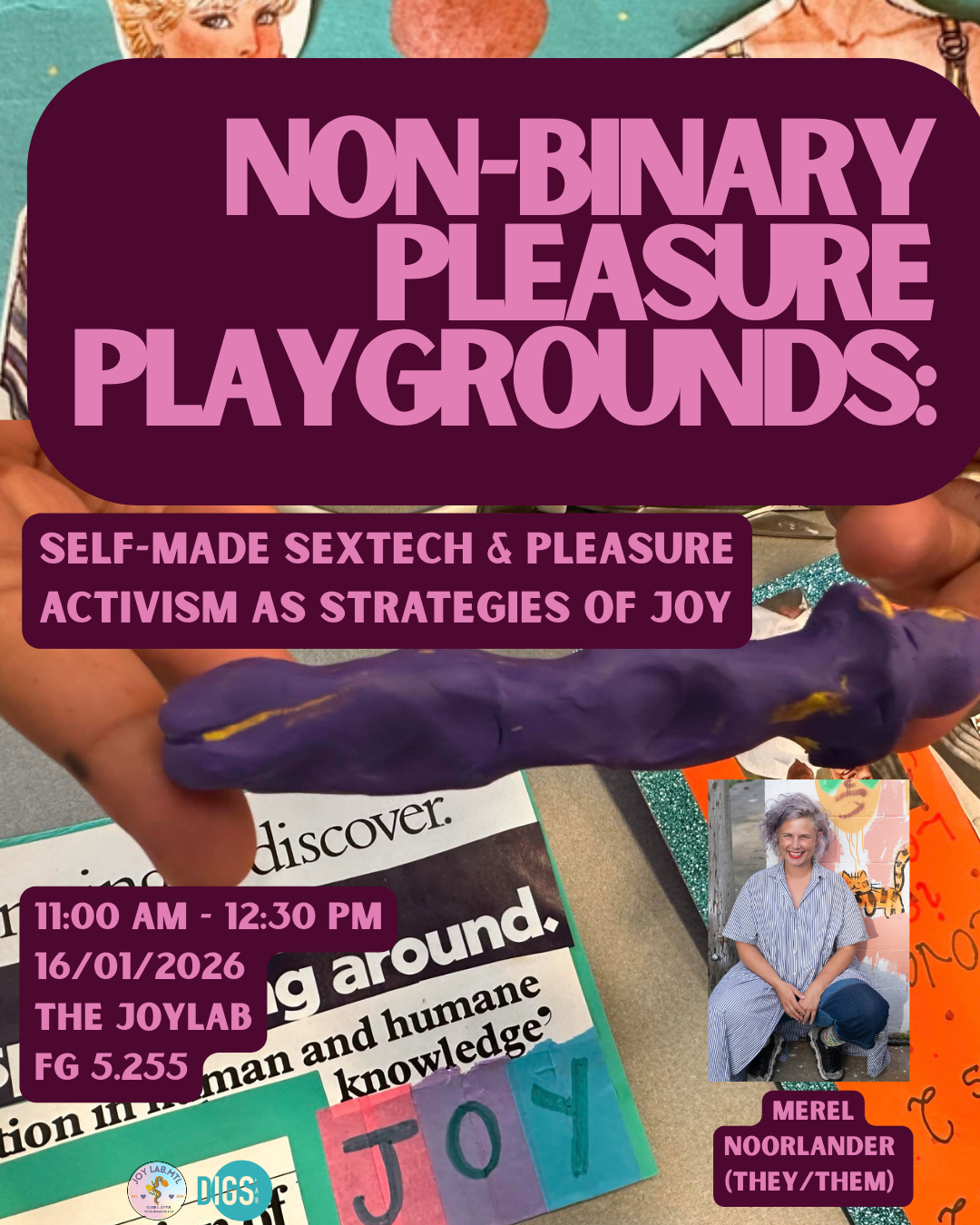
Merel Noorlander: Non-Binary Pleasure Playgrounds: Self-made Sextech and Pleasure Activism as Strategies of Joy
Jan
16
11:00 AM11:00

Merel Noorlander: Non-Binary Pleasure Playgrounds: Self-made Sextech and Pleasure Activism as Strategies of Joy

On January 16, the DIGS Lab is co-hosting a talk by Merel Noorlander, Non-Binary Pleasure Playgrounds: Self-made Sextech and Pleasure Activism as Strategies of Joy in collaboration with the JOY LAB. There is no registration for this event.

This guest lecture presents research situated at the intersections of physical and digital intimacy, queer identity, and sextech. It takes an interdisciplinary approach, combining community-based media design, interactive installations, and participatory processes to examine how speculative and community-based design practices can (re)imagine intimacy beyond normative frameworks, particularly within queer, trans, immigrant, and sexwork communities. Noorlander’s artistic research spans kinetic installations, ceramics, mobile projection mapping, and fieldwork on self-made pleasure objects. It explores how materiality, digital embodiment, and public space operate as sites of both pleasure and resistance.

Central to this work is the question:
When we look at public areas as queer and sex-positive spaces, what vernaculars, gestures, scents, sounds, and colors do we use to communicate? How do these evolve, intersect, and influence personal and cultural understandings of intimacy, and what tools support these interactions?

This research draws on Paul B. Preciado’s work on gender non-conforming identities, extending broader explorations of contemporary intimacy through technology and fluid ways of being. In practice, it investigates self-made queer sextech in everyday life, of all ages, combining theoretical inquiry with social practice. This includes weaving pleasure-oriented objects and installations into both public and private spaces, highlighting how artistic production can function as critical social intervention.Collaboration and co-creation is central to this work. It engages BDSM practitioners, sex coaches, sex workers, and queer and trans communities that I'm part of, in developing physical and digital self-made sex toys, translating diverse experiences into a shared visual and interactive language. A key conceptual framework guiding this research is pleasure activism, knowledge exchange and joy as a strategy for social change right at each others doorstep, empowering communities outside mainstream structures. By situating these practices within multidisciplinary art installations, this work integrates personal narratives, participatory research, and long-term interdisciplinary reflection. This lecture also invites the audience to actively reflect on their role in joy, pleasure activism, and the creation of self-made pleasure objects.

Speaker bio: Merel Noorlander (they/them) is a Dutch artist, designer, curator, and educator, navigating between Salt Lake City, Detroit, New York, and Amsterdam, raised in Amsterdam’s Red‑Light District among a self‑chosen queer family and captaining their own boat. They hold an MFA in 4D Design from Cranbrook Academy of Art and a BFA from the Royal Academy of Art, The Hague. Their work centers on community-based media, participatory design, and strong collaboration with LGBTQIA+, migration, and sex‑work communities. Currently, they serve as Visiting Assistant Professor in the Multi-Disciplinary Design Division at the University of Utah and lead a research group on “Queer Self‑made Sextech + Materials” with the SexTech Lab at The New School in New York, alongside Pani Farvid. They are also part of the accelerator program for their research under the mentorship of Bryony Cole at the SexTech School, Cohort 14. Merel is currently working on two book chapters: Social Practice & Participatory Design with the University of Buffalo, NY, and Queer Selfmade Sextoys in collaboration with York University, Toronto, Canada (Beyond the Interface Symposium, part of the Critical Trafficking and Sex Work Studies research group, peer-reviewed by Kathleen Cherrington), as well as a book proposal on SexTech, Pleasure, Joy, and Social Justice with Pani Farvid and their research team.

View Event →
Graduate seminar with Dr Łukasz Szulc
Nov
6
10:00 AM10:00

Graduate seminar with Dr Łukasz Szulc

On November 6, following the talk on Glocal Political Economy of Queer Dating in Poland, we will be hosting a graduate seminar with Dr Łukasz Szulc. The graduate seminar is envisioned as a space for discussion on current developments in technologies of intimacy and issues of transnationalism in queer digital media research. To prompt conversation, we will be reading two short collaborative articles Szulc has co-authored:

Coffee, tea and light snacks will be served. If you wish to participate, sign up by sending an email indicating your name, study level and department to digslab@concordia.ca, as the seminar has limited capacity. If you have any questions/accommodation requests, please don’t hesitate to reach out to us.

Dr Łukasz Szulc is a Senior Lecturer in Digital Media and Culture at the University of Manchester. His research focuses on critical and cultural studies of digital media particularly at the intersections of gender sexuality and transnationalism. He co-edited the 2024 Special Issue of Communication Culture and Critique on ‘Transnational Queer Cultures and Digital Media’ (with Yener Bayramoğlu and Radhika Gajjala) and is the author of the book Transnational Homosexuals in Communist Poland: Cross-Border Flows in Gay and Lesbian Magazines (2018).

View Event →
[Talk and Graduate Seminar] Dr Łukasz Szulc: Glocal Political Economy of Queer Dating in Poland
Nov
5
2:00 PM14:00

[Talk and Graduate Seminar] Dr Łukasz Szulc: Glocal Political Economy of Queer Dating in Poland

In-person event.

Please register your attendance here.

In November, the Digital Intimacy Gender and Sexuality (DIGS) Lab will be hosting Dr Łukasz Szulc (University of Manchester) for a talk on the Glocal Political Economy of Queer Dating in Poland. The public talk will be followed by a graduate seminar with the author.


About the talk: Dating is increasingly mediated by digital technologies most of which are developed by US companies despite their global reach. This concentration raises critical questions about the standardisation of intimacy and the implications of entrusting personal relationships to a small number of for-profit platforms. Against the backdrop of rapid technological change large-scale migration and intensified cross-cultural exchange this talk explores the evolution of transnational dating cultures through the lens of Polish queer experiences. Szulc traces the development of dating media over the past four decades beginning with personal ads in community magazines and queer chatrooms on mainstream Polish portals. This is followed by the emergence of both national and international queer dating websites—such as Poland’s Queer.pl and Germany’s Romeo.com—and later the global dominance of mobile apps like Grindr and Her. Alongside this historical trajectory he analyses the ownership structures business models and governance frameworks that shape how these technologies operate. These media histories are situated within broader geopolitical transformations particularly Poland’s shift from state socialism to democracy and capitalism after 1989. By centring Polish queer perspectives Szulc highlights how intimacy is mediated by intersecting cultural social and political contexts challenging Western-centric accounts of digital dating.

Speaker bio: Dr Łukasz Szulc is a Senior Lecturer in Digital Media and Culture at the University of Manchester. His research focuses on critical and cultural studies of digital media particularly at the intersections of gender sexuality and transnationalism. He co-edited the 2024 Special Issue of Communication Culture and Critique on ‘Transnational Queer Cultures and Digital Media’ (with Yener Bayramoğlu and Radhika Gajjala) and is the author of the book Transnational Homosexuals in Communist Poland: Cross-Border Flows in Gay and Lesbian Magazines (2018).

View Event →
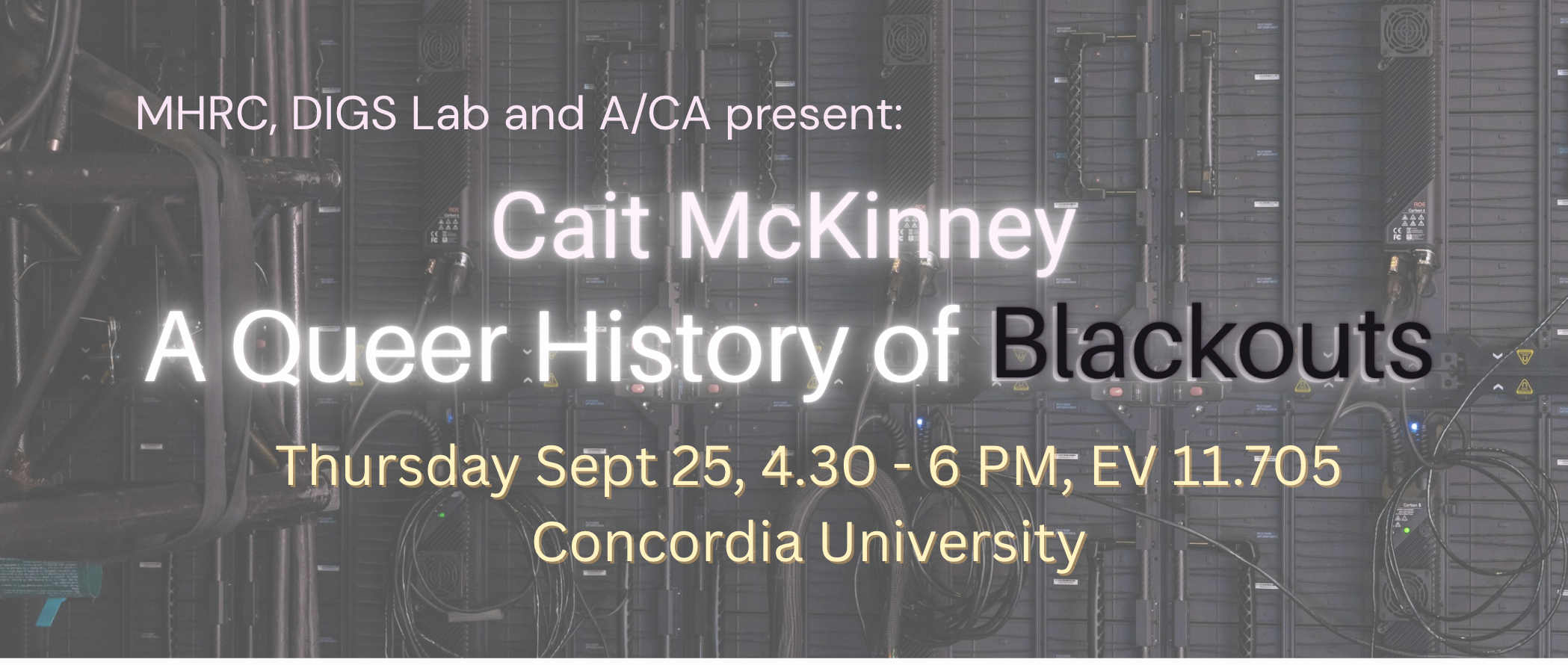
Cait McKinney: A Queer History of Blackouts
Sep
25
4:30 PM16:30

Cait McKinney: A Queer History of Blackouts

In-person event.

Please register your attendance here.

Media History Research Center (MHRC), DIGS Lab and Archive/Counter Archive (A/CA) are delighted to invite you to Dr Cait McKinney’s talk “A Queer History of Blackouts,” followed by a graduate seminar with the author.

In this talk, McKinney offers a media history of the online blackout as a digital tactic grounded in 1990s AIDS activism. “Blackout” protests evoke power grid failures, temporarily shutting down online systems by removing content, blocking access, or replacing content with black imagery. This lasting tactic began with New York-based Visual AIDS and Creative Time's Day Without Art online blackout (1995–2000), which drew attention to the AIDS crisis as a systemic failure to care for minoritized people. The protest asked participating sites to adopt a small banner graphic and redact their websites for the day. McKinney argues that an AIDS-informed perspective on infrastructure collapse and systemic exclusion shaped blackouts. This history helps us understand how and why blackouts trade in feelings of frustration with broken systems. The author situates this historical analysis of the online blackout in a wider queer media theory of blackouts as impasses in which affective life abruptly shifts in generative ways.

The public talk will be followed by a graduate seminar on Friday, September 26 from 10am to 12pm. The seminar has limited capacity, so please register your attendance here. For more information about the talk, write to MHRC coordinator, Laura Pannekoek laurapannekoek@gmail.com, and for more information about the graduate seminar, reach out to A/CA representative Hannah Schallert at hannah.schallert@gmail.com.

Cait McKinney is the author of I Know You Are, but What Am I? On Pee-wee Herman (Minnesota 2024) and Information Activism: A Queer History of Lesbian Media Technologies (Duke 2020). They are associate professor of communication at Simon Fraser University. 

View Event →
Dr. Mar Hicks on Disrupting Computing History (Virtual event)
Sep
18
6:00 PM18:00

Dr. Mar Hicks on Disrupting Computing History (Virtual event)

Virtual Event

Please register on this link to get the Zoom event details. There is no fee required to attend this event. It will be professionally live captioned.

Dr. Mar Hicks will speak about Disrupting Computing History to Align Technology’s Past and Present

Mar Hicks is an author, historian, and professor doing research on hidden histories of computing, as well as the history of labor and technology. Hicks is currently an Associate Professor at The University of Virginia's School of Data Science, in Charlottesville, teaching courses on the history of technology, computing and society, and the larger implications of powerful and widespread digital infrastructures. Their research focuses on how gender and sexuality bring hidden technological dynamics to light, and how the experiences of women and LGBTQIA people change the core narratives of the history of computing in unexpected ways. Hicks's multiple award-winning book, Programmed Inequality, looks at how the British lost their early lead in computing by discarding women computer workers, and what this cautionary tale tells us about current issues in high tech. Their new work looks at resistance and queerness in the history of technology. Hicks is also co-editor of the book Your Computer Is On Fire (MIT Press, 2021), a volume of essays about how we can begin to fix our broken high-tech infrastructures. Other writing and more information can be found at: marhicks.com.

This event is co-hosted by the DIGS Lab (Digital Intimacy, Gender, and Sexuality Lab of Concordia University) and The Feminist and Accessible Publishing, Communications, + Tech Series.

This event is also part of the 7th Season of Disrupting Disruptions: the Feminist and Accessible Publishing and Communications Technologies Speaker and Workshop Series, organized by Dr. Alex Ketchum. Our series was made possible thanks to our sponsors: SSHRC, Digital Citizen Research, the Institute for Gender, Sexuality, and Feminist Studies (IGSF), the DIGS Lab, Milieux, Initiative for Indigenous Futures, ReQEF, and more.

View Event →
[Online Lecture] Dr. Carlo Handy Charles: Queer Transnational Space
Jun
14
2:00 PM14:00

[Online Lecture] Dr. Carlo Handy Charles: Queer Transnational Space

Queer Transnational Space: How dating apps shape romantic connections and intimate cross-border relationships among Haitian queer migrants and nonmigrants

Online event

Please register for the event here with your institutional email address to receive a Zoom link for the event.

In the literature on queer/sexual migration, scholars (Luibhéid 2004, 2008; Manalansan 2006; Cantú et al. 2009; Carrillo 2017; Murray 2020; Tamagawa 2020) have shown how sexuality shapes the migration and integration processes of LGBTQ+ migrants from mainly the Global South to the Global North. In doing so, they have demonstrated that sexuality is a dimension of power that shapes not only why and how LGBTQ+ people move across national borders but also how they integrate into their host societies. While this body of scholarship has provided significant insights into how sexuality intersects with migration to shape the living conditions and life outcomes of LGBTQ+ people globally, they often underexamine the role of dating apps, such as Grindr, Tinder, and Facebook dating, among others, in shaping romantic connections and intimate cross-border relationships among queer migrants and nonmigrants. Dr. Carlo Handy Charles argues in his book project that dating apps play a key role in how co-ethnic/co-national queer migrants and nonmigrants develop transnational connections and same-sex intimate relationships, leading them to migrate or temporarily move across their transnational social space, i.e., their home and host countries. In doing so, Charles’ research contributes to the literature on queer/sexual migration and transnationalism by showing how digital intimacy shapes LGBTQ+ people’s migration and integration processes and their mobility across transnational social spaces.  

Bio:

Dr. Carlo Handy Charles (he/him) is an Assistant Professor of Sociology at the University of Windsor and a Visiting Scholar in the Digital Intimacy, Gender, and Sexuality Lab at Concordia University. He is also a former Vanier Scholar, Pierre Elliott Trudeau Scholar, and a Fellow at the Institut Convergences Migrations at the CNRS and Collège de France in Paris. His current book project with the University of Chicago Press examines how socio-economic inequalities, sexuality, and space shape transnational same-sex intimate relationships among Haitian men in Haiti, the United States, Canada, France, Brazil, Chile, and the Dominican Republic. He received a Ph.D. in Sociology at McMaster University and a Ph.D. in Geography at the Université des Antilles in 2023. Prior to joining the University of Windsor, he taught Sociology at McMaster University and French at L'Alliance Française de Toronto and L'Alliance Française de Caracas (Venezuela). Beyond academia, he is an award-winning essayist and the co-author of the critically acclaimed Kap O Mond, a play focusing on Haitian migration in France. He is also a public policy advisor, currently working on the Toronto Francophone Affairs Advisory Committee. His publications have appeared in over two dozen academic journals and news media in Canada and internationally. For more information about him and his research, please visit: www.uwindsor.ca/sociology/CarloCharles 

View Event →
[Research Talk] Rendering Desired Spaces: Crafting Methods for New Digital Geographies
Mar
22
3:00 PM15:00

[Research Talk] Rendering Desired Spaces: Crafting Methods for New Digital Geographies

  • Speculative Life Research Cluster (EV 10.625) (map)
  • Google Calendar ICS

This research talk explores the work of Lotte de Jong and Antonia Hernández addressing the spatial construction of desire on sex webcam platforms and real estate role-playing pornography. Through an overview of different artworks created between 2018-2024, the authors highlight how these digital spaces serve as unique sites for investigating issues related to housing anxiety and desire, the governance of visibility, and the representation and inhabitation of virtual environments. They will also address the benefits and challenges of using arts-based methods and interdisciplinary collaboration to explore rapidly changing phenomena.

After the talk, we invite you to join us for a screening of Jong’s and Hernández’s Fantasy Lane (work in progress) which will take place on the same day at 5 pm at the Visualization Studio (Webster Library, LB-314.00).

Fantasy Lane explores the libidinal aspect of the housing crisis and unattainable fantasies about homeownership through the rise of real estate role-playing porn videos. These videos are transformed through computer vision, turning the spaces into 3D navigable environments that, accompanied by ASMR narration and user-generated comments, allow the exploration of desired spaces rendered from abstraction and probabilities.


Bios

Lotte Louise de Jong is a Rotterdam-based multidisciplinary artist with a film and lens-based media background. Through website-based works, VR, and video installations, she explores identity, intimacy, economy, and sexuality in the digital realm. Lotte's research-driven approach combines humor with critical reflection to shed light on our hidden online lives and societal impact.


Antonia Hernández is an artist and assistant professor in the Communication department at Concordia University, Montréal. Her work explores the poetic dimensions of governance and the domestic aspects of platforms. Currently, she is developing a video opera addressing the financialization of water in Chile.


Cover image credit: Lotte de Jong & Antonia Hernández

View Event →
The Two Revolutions: A History of the Transgender Internet – Book talk with Dr. Avery Dame-Griff
Nov
2
6:30 PM18:30

The Two Revolutions: A History of the Transgender Internet – Book talk with Dr. Avery Dame-Griff

  • 3487 Rue Peel Montréal, QC, H3A 1W7 Canada (map)
  • Google Calendar ICS

3487 rue Peel, Montreal & Online

Register here.


The DIGS Lab and McGill’s Feminist and Accessible Publishing, Communications, and Technology Speaker Series will be hosting Dr. Avery Dame-Griff to discuss his new book. The Two Revolutions explores how the rise of the internet shaped transgender identity and activism from the 1980s to the present. Dame-Griff traces the digital networks of transgender activists, cross-dressing computer hobbyists, and others interested in gender nonconformity who incited the second revolution of the title: the ascendance of “transgender” as an umbrella identity in the mid-1990s. Through a history of how trans people online exploited different digital infrastructures in the early days of the internet to build community, Dame-Griff explores a crucial part of trans history—illuminating how we arrived at our contemporary moment and what lessons this history can offer in a moment of moral panic.

View Event →
Kath Albury: "Digital sexual health - from literacies to capabilities"
Oct
16
4:00 PM16:00

Kath Albury: "Digital sexual health - from literacies to capabilities"

  • McGill University - Leacock Building (map)
  • Google Calendar ICS

Hybrid event

Register here to confirm your attendance and receive a Zoom link.

Digital literacy education is often proposed as a panacea for a range of everyday sexual health and wellbeing concerns - from 'safe sexting' and dating app use, to consent education. Sexual health workforces, too, are increasingly required to adopt data-driven digital technologies and practices (sometimes referred to as eHealth or mHealth) to undertake core activities such as clinical service provision, health promotion, education and outreach, reporting and quality assurance. This presentation draws on preliminary findings of sociotechnical research investigating the intersection of sexual health, digital literacy, and data literacy. It uses interviews with sexual health researchers and practitioners, and the findings of a narrative literature review, to identify current limitations in sexual health research addressing “digital literacy for sexual health.” Current 'digital health literacy' discourse tends to frame literacy in terms of individual deficit - and exclude the digital and data literacies of health workforces from consideration. I propose alternative (and less morally loaded) frameworks of digital and data capability for sexual health, building on recent participatory research with members of the not-for-profit workforce. This 'capabilities approach' attends to the complexities of digital health practice, while remaining mindful of the social and political factors that are critical to sexual health and wellbeing.

Dr. Kath Albury is an Australian Research Council Future Fellow, leading the 'Digital and data capabilities for sexual health ' project. She is also an Associate Investigator in the Swinburne University of Technology Node of the Australian Research Council Centre of Excellence for Automated Decision-Making and Society. She is a Chief Investigator on the Swedish/Australian collaboration 'Digital sexual health: Designing for safety, pleasure and wellbeing in LGBTQ+ communities'. Kath's past projects investigated young people’s practices of digital self-representation, and the role of user-generated media (including social networking platforms and dating apps) in young people’s formal and informal sexual learning, safety and wellbeing practices. Her recent co-authored books include: Everyday Data Cultures (with Jean Burgess, Anthony McCosker and Rowan Wilken, Polity 2022) and Data for Social Good: Non-Profit Sector Data Projects (with Jane Farmer, Anthony McCosker and Amir Aryani, Palgrave Macmillan Open Access 2023).

This event is hosted by McGill University’s ACHS (Art History and Communication Studies), Concordia's DIGS Lab, and supported by the IGSF and Disrupting Disruptions: the Feminist and Accessible Publishing and Communications Technologies Speaker and Workshop Series.

Image source: "iOS Medical Apps on an iPhone 6" by integratedchange is licensed under CC BY 2.0.

View Event →
Sep
22
10:00 AM10:00

Seminar with Sarah Sharma

Following the talk “Broken Machines: Towards a Techno-Feminist Refusal” by Dr. Sarah Sharma on September 21st, MHRC and DIGS are hosting a small graduate seminar with Sarah Sharma on September 22nd at 10 a.m. in CJ 4.223. We will be discussing the preface and introduction to Re-Understanding Media; Feminist Extensions of Marshall McLuhan. Please register for the graduate seminar here: https://www.eventbrite.co.uk/e/seminar-with-sarah-sharma-tickets-715594892587?aff=oddtdtcreator

View Event →
Dr. Sarah Sharma on “Broken Machines: Towards a Techno-Feminist Refusal”
Sep
21
5:00 PM17:00

Dr. Sarah Sharma on “Broken Machines: Towards a Techno-Feminist Refusal”

  • EV 11.705, EV Building, Concordia SGW Campus (map)
  • Google Calendar ICS

EV 11.705, EV Building, Concordia SGW Campus

5:00-7:00pm

Register here.

You’re invited to this seminar co-hosted by the Media History Research Center and DIGS Lab. Dr. Sarah Sharma is Associate Professor of Media Theory and Director of the Institute of Communication, Culture, Information and Technology (ICCIT) at the University of Toronto. She is the author of In the Meantime: Temporality and Cultural Politics (Duke UP, 2014). This book challenges the popular sentiment that the world is "speeding up" and locates instead how temporality operates as a key relation of power structured at the intersection of a range of social differences and technologies. Her edited volume (with Rianka Singh) Re-Understanding Media: Feminist Extensions of Marshall McLuhan (Duke UP 2022) highlights her time as director of the McLuhan Centre between 2017-2022 and retrieves a feminist version of "the medium is the message." Sarah is currently working on a new book (tentatively titled Broken Machine: Towards a Techno-feminist Refusal) which advances a techno-feminist media theory to account for Big Tech and the gendered politics of utility, exit and repair. Registered participants will receive a chapter of the book to read in preparation.

View Event →
Digital Intimacies Pop-up Exhibition
Jul
11
to Jul 13

Digital Intimacies Pop-up Exhibition

  • 4th Space (Room LB-103) (map)
  • Google Calendar ICS

The Research-Creation Collective (RCC) is a collaborative project involving members of the DIGS lab and Feminist Media Studio. This year the RCC has co-curated Digital Intimacies, an exhibition exploring the impacts of digitization on our understanding of intimacy through diverse research-creation projects.

Inspired by Lauren Berlant’s attestation that “the kinds of connections that impact people, and on which they depend for living (if not ‘a life’), do not always respect the predictable forms,” Digital Intimacies seeks to understand how intimacy could be conceptualized and creatively explored differently than “predictable forms” (Berlant 1998, 284).

When? July 11-13, 2023 (10am – 6pm daily)

Where? 4th Space, SGW Campus (Room LB-103 @ 1400 De Maisonneuve Blvd. W.)

View Event →
Mobilizing Data for Justice: A Skills Development Workshop in Data Activism
May
5
to May 7

Mobilizing Data for Justice: A Skills Development Workshop in Data Activism

Interested in learning how to do data activism? Join the Data Justice Hub’s FREE workshop May 5th to 7th on Mobilizing Data for Justice: A Skills Development Workshop in Data Activism.  This is a three-day skills development workshop where activists and critical researchers can learn methods for making sense of and engaging with data in social struggles.

We have invited activists from around the world to share their experiences doing data activism. The workshops will focus on three areas:

  • Visualizing: how can activists and critical researchers deploy techniques, such as mapping and countermapping, to visualize social justice issues in new ways?

  • Archiving: how can activists and critical researchers effectively engage with archives in getting access to data and curate their own community-based archives in thinking about data differently? 

  • Surveillance: how can activists and critical researchers identify and negotiate surveillance infrastructures in organizing their work?

The event will be interactive, emphasizing dialogue, with the aim of creating opportunities for activists and researchers to troubleshoot ideas together.

To attend the workshop IN PERSON, you can register here

To register for our ONLINE sessions, please go here.

Registration is open until April 16, 2023.

This workshop is organized by the Data Justice Hub and sponsored by the DIGS Lab, among others. Click here to see the full list of sponsors.

View Event →
Dr. Marika Cifor on Viral Cultures: Activist Archiving in the Age of AIDS: the Visual AIDS’s Archive
Mar
8
6:00 PM18:00

Dr. Marika Cifor on Viral Cultures: Activist Archiving in the Age of AIDS: the Visual AIDS’s Archive

Dr. Marika Cifor will speak about Viral Cultures: Activist Archiving in the Age of AIDS: the Visual AIDS’s Archive Project and Artist+ Registry. The talk will be followed by an audience Q and A.

This event is part of the 5th Season of the Feminist and Accessible Publishing and Communications Technologies Speaker and Workshop Series, organized by Dr. Alex Ketchum and co-hosted by the DIGS Lab.


Dr. Marika Cifor is an Assistant Professor in the Information School at University of Washington and an adjunct faculty member in Gender, Women & Sexuality Studies. She is a feminist scholar of archival studies and digital studies. My research investigates how individuals and communities marginalized by gender, sexuality, race and ethnicity, and HIV-status are represented and how they document and represent themselves in archives and digital cultures. This multidisciplinary scholarship uncovers how archives and digital technologies and cultures are shaping identities, experiences, and social movements.


View Event →
Digital Text as Data – A Computational Approach by Dr. Zhifan Luo
Feb
15
10:00 AM10:00

Digital Text as Data – A Computational Approach by Dr. Zhifan Luo

A deeply digitalized social world has brought studies of media to an “Age of Data Abundance,” which comes with its own opportunities and challenges. For a new generation of scholars, proper methodological tools are indispensable if they want to harvest the opportunities while facing up to the challenges of the digital age. In this workshop, participants will be introduced to a computational approach to collect, analyze, and visualize digital text as data. In the first part of the workshop, they will learn about how computational methods may complement, advance, and transcend traditional ways of studying media through cases. In the second part, they will get a chance to do hands-on exercises and play with R, a programming language widely used by social scientists, to collect and/or analyze some social media data.


Dr. Zhifan Luo is an assistant professor in the Department of Sociology & Anthropology at Concordia University. She obtained a doctoral degree in sociology from the State University of New York at Albany, the U.S. Her research and teaching integrate computer-assisted content analysis with traditional qualitative and quantitative methods to investigate the dynamics of power and resistance in the authoritarian and democratic contexts. Her work has appeared in New Media & Society, Information, Communication & Society, The SAGE Handbook of Social Media Research Methods (2nd edition), and others.

To register, go to: https://www.eventbrite.ca/e/digital-text-as-data-a-computational-approach-tickets-523765636117

View Event →
DIGS Whiteboard Talks
Dec
8
2:00 PM14:00

DIGS Whiteboard Talks

We’re making space for folks within the DIGS Network to come together and talk about their research. Join us for this relaxed get-together to hear about the latest ideas, concepts, or projects that others are working on.

To present: We’re looking for 3 people to give an informal 5-minute talk about their research. This can be an overview of a project or a detailed discussion of a particular method, theory, or idea. No fancy slides and no prep needed, just you and a whiteboard marker (if you want it!) expanding our minds. Talks will be followed by Q&A.

Please email hannahjgoldapel@gmail.com with the subject "DIGS Whiteboard Talks" if you would like to present in this round of talks!

December 8, 2:00 – 3:30 pm
Milieux Institute Atelier (EV 11.425)
Click here to register.

DIGS Network events are aimed at gathering graduate students, scholars, and faculty mainly from Concordia and local academic institutions together for discussion and sharing relating to our overlapping research interests.

View Event →
Guest lecture by Dr. Sobande: Black Feminist Approaches to Digital Experiences, Archiving, and Opacity
Nov
14
2:30 PM14:30

Guest lecture by Dr. Sobande: Black Feminist Approaches to Digital Experiences, Archiving, and Opacity

This online guest lecture is open to all interested students and scholars. Advance registration is required at this link: https://concordia-ca.zoom.us/webinar/register/WN_Ivzeqyh8Snin6HOmKbRnAw

Please use your institutional email address to register if possible.


How are Black feminist approaches to digital experiences and archiving practices shaping Black history and futures? How do these archival approaches enable Black feminists to play with forms of opacity in ways that subvert the gaze of institutions? Can Black feminist digital archiving efforts result in a redefinition of what it means to archive? Focusing on aspects of Black feminist digital archiving experiences, and research on Black Scottish history, this session considers the role and pursuit of forms of opacity as part of such efforts. Moving beyond a focus on questions of visibility and publicness, this session involves an emphasis on elements of the interiority of Black feminist digital archiving work, including the generative nature of refusing demands of "transparency".

Dr Francesca Sobande is a senior lecturer in digital media studies at Cardiff University. She is the author of The Digital Lives of Black Women in Britain (Palgrave Macmillan, 2020) and Consuming Crisis: Commodifying Care and COVID-19 (SAGE, 2022). Francesca is also co-editor with Akwugo Emejulu of To Exist is to Resist: Black Feminism in Europe (Pluto Press, 2019), and is co-author with layla-roxanne hill of Black Oot Here: Black Lives in Scotland (Bloomsbury, 2022).


This event is hosted by the Digital Intimacy, Gender and Sexuality (DIGS) Lab and will take place as part of the course COMS 472/521 Communication Technologies and Gender, with the support of Concordia’s Department of Communication Studies.


View Event →
Documentary Poetry Workshop with Sallie Fullerton
Nov
10
2:00 PM14:00

Documentary Poetry Workshop with Sallie Fullerton

In this event, co-hosted with the Feminist Media Studio, we will explore the genre of documentary poetry – poetry that seeks to document and ground itself in an historical moment through incorporating words, images, sound, video, etc – as a means of archival translation that uncovers and preserves the ambiguities of history.

We will explore existing documentary poetry work ranging from 20th century authors Mariel Rukeyser and Charles Reznikoff to contemporary works by Claudia Rankine, CD Wright, Mark Nowak, and M NourbeSe Philip. We will also experiment with documentary poetry techniques, incorporating photographs, historical or technical documents, audio transcriptions and other archival marginalia into our own works. Participants are invited to bring a photograph and a letter relating to a subject of their choice. Otherwise, materials will be provided.

November 10, 2:00 – 4:00 pm
Click here to register.

DIGS Network events are aimed at gathering graduate students, scholars, and faculty mainly from Concordia and local academic institutions together for discussion and sharing relating to our overlapping research interests.

View Event →
DIGS Reading Group "Read What You Want"
Oct
28
1:00 PM13:00

DIGS Reading Group "Read What You Want"

This year, we’re doing reading groups a little bit differently. We want to hear about what you’re already reading, and why! At our “Read What You Want” Reading Group, join us to discuss a book, chapter, or article you’ve recently read and share how it has been impactful for your own research or scholarly development.

October 28, 1:00 – 3:00 pm

Click here to register.

DIGS Network events are aimed at gathering graduate students, scholars, and faculty mainly from Concordia and local academic institutions together for discussion and sharing relating to our overlapping research interests.

View Event →
DIGS Welcome Back & Digital Knowledge Share
Sep
29
2:00 PM14:00

DIGS Welcome Back & Digital Knowledge Share

Kick off the year with us at this welcome back and knowledge-sharing session. This event is open to anyone previously affiliated with DIGS and anyone who wants to get involved this year. This will be an opportunity to get to know the lab, meet new people, and get a sense of overlaps in our research interests. The second part of this event will be a knowledge sharing workshop in which we create a collaborative repository for digital research tools and resources that are (or could be) useful to digital research across the DIGS network!

September 29, 2:00 – 4:00 pm
Click here to register.

DIGS Network events are aimed at gathering graduate students, scholars, and faculty mainly from Concordia and local academic institutions together for discussion and sharing relating to our overlapping research interests.

View Event →
Dr. Stefanie Duguay and Dr. Alex Ketchum on Queer Women's Communication Networks: A Book Event
Sep
24
2:00 PM14:00

Dr. Stefanie Duguay and Dr. Alex Ketchum on Queer Women's Communication Networks: A Book Event

During the event, Dr. Alex Ketchum and Dr. Stefanie Duguay will discuss queer women's communication networks. The event will include presentations from both authors, a fireside chat, and an audience Q and A period. Books will be available for purchase. Tea and cookies will be served.

September 24, 2:00 – 3:30 pm
L'Euguélionne
Click here to register.

View Event →
Book Launch – Engage in Public Scholarship!
Jul
19
6:00 PM18:00

Book Launch – Engage in Public Scholarship!

The DIGS Lab and Concordia University Press will be co-hosting this celebration of the launch of Dr. Alex Ketchum’s new book “Engage in Public Scholarship: A Guidebook on Feminist and Accessible Communication.”  


Public scholarship – sharing research with audiences outside of academic settings – has become increasingly necessary to counter the rise of misinformation, to fill gaps from cuts to traditional media, and to increase the reach of important scholarship by making it available to the public. However, engaging in these efforts also comes with the risk of harassment and threats – especially for women, people of colour, queer communities, and precariously employed workers. Engage in Public Scholarship! provides constructive guidance on how to translate research into inclusive public outreach while ensuring that such efforts are accessible for a range of abilities as well as safer for those involved. 


Alex D. Ketchum is the faculty lecturer in the Institute of Gender, Sexuality, and Feminist Studies at McGill University. 


This event is by invitation only due to the size of the space and restrictions to the number of attendees for catering purposes. If you are interested in attending, please contact Alexandra[dot]ketchum[at]mcgill[dot]ca 

View Event →
DIGS April Reading Group - "Information and Power" in The Panoptic Sort by Oscar H. Gandy Jr.
Apr
1
1:00 PM13:00

DIGS April Reading Group - "Information and Power" in The Panoptic Sort by Oscar H. Gandy Jr.

The reading group is designed to reflect on literature across disciplines that relates to the DIGS Lab’s mandate and to provide a space of learning and knowledge exchange.

This month’s reading is pp. 29–39 & 50–69 of Chapter 2 "Information and Power" in The Panoptic Sort by Oscar H. Gandy Jr.

To attend: The event will take place on April 1st from 1:00-2:00 pm in the Milieux Atelier (EV 11.425). It will also be streamed for those who cannot make it in person. Click here to register.

Here is the download link for the reading from the Concordia library: https://ebookcentral-proquest-com.lib-ezproxy.concordia.ca/lib/concordia-ebooks/detail.action?docID=6685723

View Event →
Robyn Caplan - Reassembling the Social Media: How to Study Platforms
Mar
28
6:00 PM18:00

Robyn Caplan - Reassembling the Social Media: How to Study Platforms

In this talk, Robyn Caplan explores how we investigate platform companies within the context of content moderation.

About this event

We spend so much time on social media, yet how much do we really know about companies currently undergirding so much of the public sphere? In this talk, Robyn Caplan, Senior Researcher at Data & Society Research Institute, explores how we investigate platform companies – as organizations and as technologies – within the context of content moderation. Together, we will examine some of the challenges of studying platforms, and what methods – such as access to these companies – can and cannot tell us about how they develop their products, policies, and practices. We will examine this in the context of the areas of platform governance and tech policy more generally, to understand how this burgeoning field is both trying to study and shape platform policies simultaneously.

Robyn Caplan is a Senior Researcher at Data & Society Research Institute and a founding member of the Platform Governance Research Network. She received her PhD from the School of Communication and Information at Rutgers University. She conducts research at the intersection of platform governance and media policy. Her research examines the impact of inter-and-intra-organizational behavior on platform governance and content moderation.

Caplan’s work has been published in journals such as Social Media + Society, First Monday, Big Data & Society, and Feminist Media Studies. Her work has been featured by publications like The Washington Post, The New York Times, Wired, NBC, and Al Jazeera. She has conducted research on a variety of issues regarding data-centric technological development including government data policies, media manipulation, and the use of data in policing.

This event is co-hosted by Concordia’s Machine Agencies group at the Milieux Institute, the Digital Intimacy, Gender and Sexuality Lab, the Department of Communication Studies, and McGill University’s Centre for Media, Technology and Democracy and the Max Bell School of Public Policy.

View Event →