
By Dunja Nešović
In January 2026, I had the pleasure of attending the Beyond the Audience: Rethinking Participation and Power in the Age of Data Capitalism conference at the ILUM University in Rome. The conference was part of a Horizon Europe research project, Mapping Media for Future Democracies (MeDeMAP), and its theme was set out with a goal of re-examining the changing role of the audience in the digital media environment that both democratizes and pluralizes, as well as governs and exploits audience participation. This meant engaging with scholarly struggles to define the audience, accompanied by terminological plurality that encompasses users, creators, prosumers, and communities, political economy approaches of regarding audience as laborers or commodity, as well as those that focalize user agency and active audience participation. Holding these multiple perspectives together sought to critically grapple with how scholarly inquiries can integrate and transcend these established, and in some cases, opposing schools of thought, in order to adequately address how mechanisms of power operate through, from, and beyond what we imagine as the audience in digital media environments.
I felt very lucky to find myself in this academic setting, as I had the chance to present a sliver of my doctoral research that directly concerns the changing role of the audience in the convergent media environment. In my presentation “Is she or isn’t she: Lesbian (in)visibility and multiauthor transmedia narrative production,” I spoke about how the intrigue around the Real Housewives of Beverly Hills star Kyle Richards’ sexuality has motivated narrative production from fans and content creators on social media. In my account, the fan narrativization and premediation practices on social media that concerned Richards’ alleged love affair with the female country singer Morgan Wade interfaced with officially produced narrative segments, creating a hybrid transmedia narrative that was, willingly or unwillingly, based on the exploitation of fans’ and content creators’ desire for knowledge and subsequent digital labor motivated by it.
The conference hosted researchers of various backgrounds, covering topics such as epistemic practices of media audiences, civic participation and audience activism, fan studies, media populism, AI and audiences, and feminist and decolonial perspectives on digital audience participation. This has enabled a chance for conversations on a multitude of scholarly approaches and objects of inquiry related to the conference theme, which spanned from empirical reception studies, highly theoretical considerations on the capture of time in capitalism and cinema, cultural and industry analyses of digital platforms, commodification of death through digital participation, influencer practices of catholic priests, to diasporic queer digital networks of care and support. In other ways, this scholarly pluralism attests to the murky waters of defining and situating the audience in the contemporary digital setting, as the fluidity and multiplicity of roles it presumes became evident through its different conceptualizations and epistemological approaches undertaken to study it.
The two keynotes by Sofie van Bauwel and Tiziana Terranova provided valuable insight into possibilities for framing digital audience, or user, participation today. Terranova’s keynote focused on some of the structural pillars of technoliberal governance of publics/audiences/users that are useful for outlining the political-economic terrain of power on digital platforms. These encompass the acquisition of human capital in platform users, rhetorical pushes of digital platforms towards building “communities” that simulate closeness and diversity, as well as algorithmic optimization mechanisms that maximize the “good” and minimize the “bad” circulation of content online. In her account, these principles set the base for building and running the digital infrastructure that politically and economically exploits and controls user engagement and is apt for the mobilization of right-wing ideologies within the fragmented digital sphere.
Meanwhile, van Bauwel addressed the concerns around rethinking audience participation through the lens of gender, noting how gender shapes participation through unequal distribution of visibility and lack of safety for women and marginalized communities, algorithmic production and governance of gender as a data variable, and feminization of audiences who are conceived as affective, emotional, and passive. Her understanding of audiences/users is multifaceted, at the same time bearing the roles of cultural interpreters, members of a commodified community, and free laborers. Bridging these perspectives, she introduced the concept of the navigator to address how being online in this capacity requires an active navigation of an environment that simultaneously subjectifies users and audiences as laborers, products, as well as relevant producers of cultural meanings.
The ongoing transformation of digital media, that is, on the one hand, fueled by the novelty imperative, and on the other, constantly re-integrating the already existing media systems (see this piece on whether everything is becoming television), requires the work of returning to concepts and frameworks we thought we were already “sufficiently” familiar with. Initiatives such as the Beyond the Audience conference provide opportunities to rethink our scholarly approaches alongside these shifts and to stimulate multidirectional inquiries that consider the structural conditions shaping our understanding of digital audience participation.
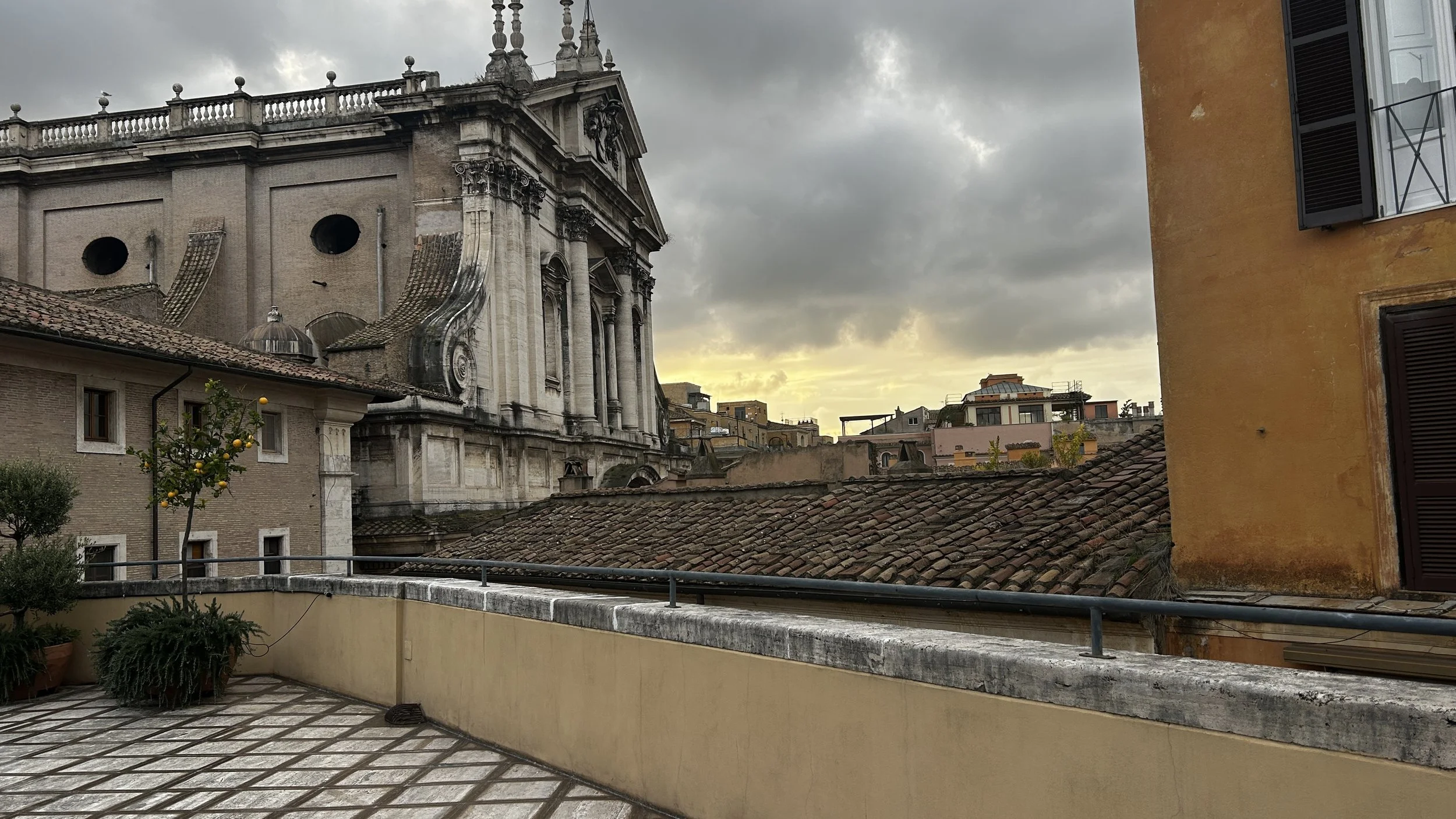
Cover image: Balcony of the IULM University Rome, taken by the author.